
.png)
This Terms of Reference (TOR) document was developed by the Energy Sector Energy Management Assistance Program (ESMAP), a global knowledge and technical assistance program administered by the World Bank (WB), under a multi-year program on Renewable Energy ResourceAssessment and Mapping that ran from October 2012 to June 2020. The TOR document is being made publicly available to facilitate future measurement campaigns that may be carried out by the World Bank Group, client governments, or other development partners.
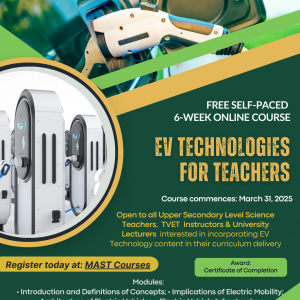
A 6-week self-paced online course: EV Technologies for Upper Secondary Level Science Teachers, TVET instructors and University Lecturers who wish to incorporate electric vehicle (EV) content in their programmes. More information can found Mona Academy of Science and Technology (MAST),. This course is offered by the University of the West Indies, Mona through the Mona Academy of Science and Technology (MAST). Click here to register: Mona Academy of Science and Technology Registration Form
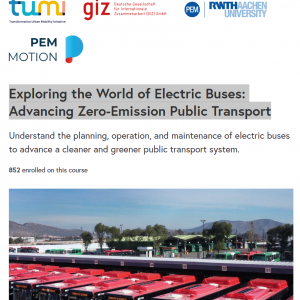
Online self-paced 6-week introductory course on electric mobility and the pathway to the integration of e-mobility in sustainable urban transport systems. The Course uses interviews, articles, videos and readings to prepare you for the future of public transport.. The course can be accessed via Exploring the World of Electric Buses: Advancing Zero-Emission Public Transport The course is offered by TUMI (Transformative Urban Mobility Initiative), who is funded by the German Federal Ministry for Economic Cooperation and Development (BMZ) and implemented by Deutsche Gesellschaft für Internationale Zusammenarbeit (GIZ) GmbH in collaboration with all TUMI partners.
.png)
A thesis submitted O'Neil Jesse Nelson in fulfilment for the degree of Master of Engineering to the Auckland University of Technology. The thesis explores the feasibilty of utility scale photovoltaic plants in Jamaica by combatting trechnical challenges with microgrids.

Although geothermal energy is globally recognized as a clean and reliable source of heat and electric power its development can inadvertently lead to adverse outcomes that disproportionately disadvantage women. Based on good practices and lessons learned, this report introduces ways that geothermal projects can mitigate risks and pursue opportunities to address gender gaps within the project cycle. It outlines the risks and opportunities associated with (i) changes in land and natural resource use, (ii) changes to employment and economic patterns, and (iii) changes to environment and health. Beyond mapping risks and opportunities, the report makes the case for focusing on...
Geothermal power production may result in significant greenhouse gas (GHG) emissions. GHG emissions from geothermal power production, mostly in the form of CO2, are generally low in comparison to traditional base load thermal energy power generation. However, as the geothermal sector has expanded, a wider range of geothermal resources have been brought into exploitation, including geothermal systems with relatively high GHG concentrations in the reservoir fluid. Recent data from Italy (Mt. Amiata) and a number of sites in Turkey show that GHG emissions from geothermal power plants can be higher than 500 g/kWh and in some cases higher than 1000...
A guideline for government officials and practitioners for tracking climate finance using our Landscape approach, and to provide answers key questions at different stages of a national climate finance tracking exercise. Click to view: Guidelines for Building a National Landscape of Climate Finance Author: Climate Policy Initiative - Chavi Meattle, Angela Falconer, Valerie Furio Keywords: Climate finance tracking, Domestic climate finance tracking.

