

This paper uses simple analytical models to study high-income donor countries' willingness to pay to supply mitigation finance to low-income countries; how this depends on modality for finance supply; and how it changes as the global greenhouse gas mitigation agenda moves forward. The paper focuses on two modalities: transformational project-based mitigation finance (transitioning from fossil to non-fossil energy use at scale), and transformational policy-based mitigation finance support (implementing comprehensive carbon taxation). These modalities are compared with conventional finance for which donors have lower willingness to pay. High-income countries' willingness to pay is higher when mitigation is combined with carbon taxation;...
Online self-paced 6-week introductory course to sustainable and equitable solutions in urban mobility, and to the “living labs” model: a method of co-development among public and private actors, researchers, and civil society to accelerate innovation in climate action and sustainable urban planning and development. The course can be accessed via MITx: Transformative Living Labs in Urban Climate Action and Transportation Planning The course is offered by Massachusetts Institute of Technology (MIT) through the edX platform.
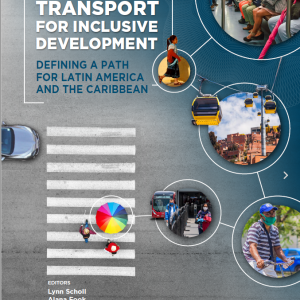
Transport for Inclusive Development: Defining a Path for Latin America and the Caribbean discusses the role that transport often plays in deepening social disadvantage and poverty, on the one hand, and its potential, on the other, to break the cycle of poverty and inequality through investments and policies that better consider the needs of poor and socially excluded groups. Keywords: Transport, Social Inclusion, Development, Latin America, Caribbean Click to download: Transport-for-Inclusive-Development-Defining-a-Path-for-Latin-America-and-the-Caribbean-1
.png)
This journal article explores the potential for increasing the share of renewables in Suriname’s electricity mix, with a special focus on the complementary role of existing hydropower and future wind power infrastructure. The article demonstrates that wind and hydro resources have great synergetic potential for displacing fossil fuel-based power generation.. The results presented in the article have relevance for climate policy in various Caribbean countries and other island states with existing hydropower infrastructure and substantial wind/solar power potential, for which this study fills an important literature gap.

The CCREEE has partnered with the Caribbean Examinations Council to produce educational resources related to energy, energy efficiency and renewable energy sources. The Virtual Lab Energy Identify and Quantify Different Energy Sources For a Home relates to CAPE Building and Mechanical Engineering Drawing Unit 1, Electrical and Electronic Engineering Technology Unit 2,and Environmental Science Unit 2, CSEC Industrial Technology (Core) and Technical Drawing and CVQ Electrical Installation Level 1 and General Construction Level 1. To access the CXC® Learning Hub Virtual Labs, go to https://learninghub.cxc.org/ and create an account or sign in if you already have an account.

In developing countries, battery storage is becoming a viable way to increase system flexibility and enable more integration of variable renewable energy. Battery energy storage systems (BESS) respond rapidly to control signals, are easy to deploy, and are benefiting from cost reduction trends. New battery technologies have valuable attributes that are well suited to the needs of developing countries. However, they have a rather short track record in terms of deployment and operation, and this can hamper efforts to reassure buyers and investors that these new technologies will perform reliably over their project life. Conditions found in some developing countries...
This document was developed by the renewable energy department of the Caribbean Community Climate Change Centre looks at different waste methods to generate energy. Key Words: waste to energy, biogas, gasification, composting and fermentation, incineration

What is the relationship between energy and climate change? How can sustainable energy impact the climate crisis?

Remote work is more environmentally friendly than working in an office. Benefits include greenhouse gas reductions particularly in relation to commuter transport. Additionally, when employers offer remote work options, they experience a better reputation, boosted customer loyalty, and have happier, healthier employees. Key Word: work from home, greenhouse gas, ghg

