
Online 4-week self-paced course on decarbonization measures in the building and transport sectors. Learn about trends in energy usage, carbon intensity, and potential of available alternatives to limit greenhouse gas (GHG) emissions. The course can be accessed via DelftX: Designing Climate-Neutral Buildings and Transport The course is offered by Delft through the edX platform.

This report provides a brief overview of the role of energy storage against the background of current trends in power systems with a particular emphasis on developing countries. It introduces the different ways in which storage can help meet policy objectives and overcome technical challenges in the power sector, it provides guidance on how to determine the value of storage solutions from a system perspective, and discusses relevant aspects of policy, market and regulatory frameworks to facilitate storage deployment. The document is intended to highlight relevant issues, provide guidance to policymakers and regulators in this relatively new area and identify...

The levelized cost of electricity is the most common indicator used to compare the cost competitiveness of electricity-generating technologies. Several studies claim that some renewable energy technologies, particularly utility-scale solar photovoltaic and onshore wind, are cost-competitive with fossil fuel–based technologies. However, there is no consensus on this point considering the wide variations in factors that influence the levelized costs of electricity across countries and technologies. This study calculates more than 4,000 levelized costs of electricity for 11 technologies, varying key input variables. The study shows that the levelized costs of electricity for renewable electricity technologies, except concentrated solar and offshore...
The Caribbean Centre for Renewable Energy and Energy Efficiency (CCREEE) invited colleagues from utilities, regulatory bodies, regional universities (lecturers and graduate students) and development partners to join us for a capacity building session focused on data collection. Prerequisites: BSc in Engineering/Relevant Discipline, or Experience in the Energy Industry Course Learning Outcomes: Understanding of the data required to complete an IRRP and the relevance of the data to the process Course Length: 2 hours (1:30 p.m. – 3:30 p.m. AST) Course Content: Weather and climate data, grid data, risk, vulnerabilities, power system data etc. This video is a complete recording of...
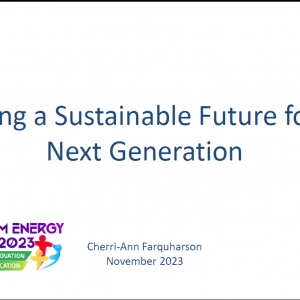
Presentation done by Cherri-Ann Farquharson, Caribbean Centre for Renewable Energy and Energy Efficiency, at the Caribbean Sustainable Energy Forum (CSEF VIII), which took place in Kingston, Jamaica, from November 7-9, 2023. The theme for CSEF VIII was ‘Powering Transport’. Connect with key national, regional, and international energy stakeholders who share the goal of accelerating the CARICOM Member States’ sustainable energy transition. Keywords: CSEF 2023Click to download: Creating a Sustainable Energy Future for the next generation

This technical guide is the second in a series of four technical guides on variable renewable energy (VRE) grid integration produced by the Energy Sector Management Assistance Program (ESMAP) of the World Bank and the Global Sustainable Electricity Partnership (GSEP). It focuses on the main functionalities, differences and benefits of various compensation devices that can be employed to increase system transfer capacity, system stability, power quality and flexibility to cope with increasing penetrations of renewables in the system. The applications of FACTS devices are associated with four essential technical enhancements of system capacity, system reliability, power quality and system controllability....

