
This video takes viewers through the tale of two fictional Caribbean countries: Sunland and Winland. Watch as planning, or a lack thereof, affects the outcome.

The Global Energy Progress Report 2019 provides a global dashboard on progress towards Sustainable Development Goal 7 (SDG7), which sets 2030 targets for reaching universal access to electricity and clean fuels and technologies for cooking, substantially increasing the share of renewable energy in the global mix, and doubling the rate of improvement of energy efficiency. All the data used in this pamphlet comes from the respective official source: for electrification, the World Bank; for clean fuels and technologies for cooking, the World Health Organization (WHO); for renewable energy, the International Energy Agency (IEA), the United Nations Statistics Division (UNSD) and...
Online self-paced 6-week introductory course to sustainable and equitable solutions in urban mobility, and to the “living labs” model: a method of co-development among public and private actors, researchers, and civil society to accelerate innovation in climate action and sustainable urban planning and development. The course can be accessed via MITx: Transformative Living Labs in Urban Climate Action and Transportation Planning The course is offered by Massachusetts Institute of Technology (MIT) through the edX platform.
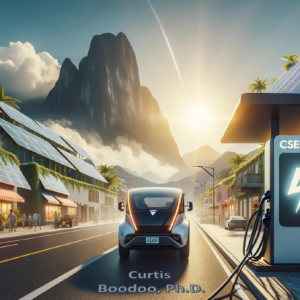
Presentation done by Dr. Curtis Boodoo, University of Trinidad and Tobago, at the Caribbean Sustainable Energy Forum (CSEF VIII), which took place in Kingston, Jamaica, from November 7-9, 2023. The theme for CSEF VIII was ‘Powering Transport’. Connect with key national, regional, and international energy stakeholders who share the goal of accelerating the CARICOM Member States’ sustainable energy transition. Keywords: CSEF 2023Click to download: Session 2 – Transportation – EV – Dr. Curtis Boodoo UTT
.png)
This journal article explores the potential for increasing the share of renewables in Suriname’s electricity mix, with a special focus on the complementary role of existing hydropower and future wind power infrastructure. The article demonstrates that wind and hydro resources have great synergetic potential for displacing fossil fuel-based power generation.. The results presented in the article have relevance for climate policy in various Caribbean countries and other island states with existing hydropower infrastructure and substantial wind/solar power potential, for which this study fills an important literature gap.
.png)
The Hydropower Sustainability Tools (HSTs) are a suite of assessment tools and guidance documents developed by a multi-stakeholder forum, aimed at driving continuous improvement in hydropower development and operations. They are useful beyond their original purpose as audit tools and can be used in World Bank Group (WBG) client countries to build capacity for sustainable hydropower. The environmental, social, and governance topics addressed by the HSTs are deliberately aligned with WBG frameworks, which provides opportunities for the tools to be used as complements to World Bank Group standards, including to help clients meet WBG requirements and support WBG staff in...

