
The 2023 Energy Report Card (ERC) for the Turks and Caicos Islands provides a standardized overview of energy sector performance across 16 Caribbean countries. It highlights key indicators such as: Installed power generation capacity (conventional and renewable) Annual electricity generation from various sources Core electricity sector metrics, including consumption, losses, and tariffs National renewable energy targets Renewable energy resource potential The 2023 Energy Report Card for the Turks and Caicos Islands also includes data and insights on energy policies and regulations, workforce development, training, and capacity-building initiatives. The information presented is primarily sourced from national ministries, agencies, and utilities responsible...

The 2023 Energy Report Card (ERC) for Trinidad and Tobago provides a standardized overview of energy sector performance across 16 Caribbean countries. It highlights key indicators such as: Installed power generation capacity (conventional and renewable) Annual electricity generation from various sources Core electricity sector metrics, including consumption, losses, and tariffs National renewable energy targets Renewable energy resource potential The 2023 Energy Report Card for Trinidad and Tobago also includes data and insights on energy policies and regulations, workforce development, training, and capacity-building initiatives. The information presented is primarily sourced from national ministries, agencies, and utilities responsible for energy and statistics,...
.png)
Achieving global goals for access to energy and mitigation of climate change will require a quadrupling of present levels of solar photovoltaic (PV) generation in the developing world by 2025 to reach around 950 gigawatt (GW)1. This represents an investment of more than US$500 billion in new solar PV generation alone. To reach this objective, large amounts of private funding will have to be unlocked to complement the limited public financing available. Yet most developing countries still lack a pipeline of bankable solar projects for consideration by the private sector. To develop one, countries must take a series of key...
A 7-week, 7 module online course on language and narratives shaping views on mobility, transport policy and mobility innovation, using homo-economicus model. The course can be accessed via Alternative Mobility Narratives The course is offered by the University of Amsterdam through the Coursera platform.
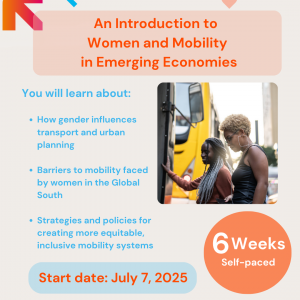
An Introduction to Women and Mobility in Emerging Economies, available from July 7. Across the globe, women encounter distinct mobility challenges that affect their access to education, healthcare, employment, and autonomy. These challenges are especially pronounced in emerging economies, where infrastructure and policy gaps often deepen gender disparities. This course provides a foundational understanding of the relationship between gender, mobility, and urban development in the Global South—and how inclusive, transformative transport policies can drive equity and sustainable progress. What you'll learn: Insights from international experts on gender and mobility Real-world case studies illustrating barriers faced by women in emerging economies...
Key Words: small island state, Antigua and Barbuda, Renewable Energy, Nationally Determined Contribution, 100% RE, Climate Change,

The energy sector worldwide faces growing challenges related to rising demand, efficiency, changing supply and demand patterns, and a lack of analytics needed for optimal management. These challenges are more acute in emerging market nations. Efficiency issues are particularly problematic, as the prevalence of informal connections to the power grid means a large amount of power is neither measured nor billed, resulting in losses as well as greater CO2 emissions, as consumers have little incentive to rationally use energy they don’t pay for. The power sector in developed nations has already begun to use artificial intelligence and related technologies that...