Online self-paced 6-week introductory course to sustainable and equitable solutions in urban mobility, and to the “living labs” model: a method of co-development among public and private actors, researchers, and civil society to accelerate innovation in climate action and sustainable urban planning and development. The course can be accessed via MITx: Transformative Living Labs in Urban Climate Action and Transportation Planning The course is offered by Massachusetts Institute of Technology (MIT) through the edX platform.
2-part course, 9 weeks, exploring the impacts of motorization, current unsustainable travel patterns, and the framework for changing to sustainable urban mobility. The course can be accessed via Transforming Urban Mobility Course. The course is offered by TUMI (Transformative Urban Mobility Initiative), who is funded by the German Federal Ministry for Economic Cooperation and Development (BMZ) and implemented by Deutsche Gesellschaft für Internationale Zusammenarbeit (GIZ) GmbH in collaboration with all TUMI partners.
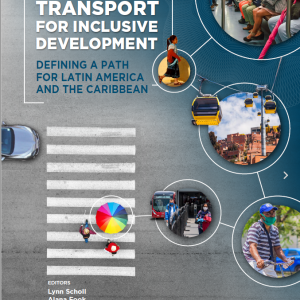
Transport for Inclusive Development: Defining a Path for Latin America and the Caribbean discusses the role that transport often plays in deepening social disadvantage and poverty, on the one hand, and its potential, on the other, to break the cycle of poverty and inequality through investments and policies that better consider the needs of poor and socially excluded groups. Keywords: Transport, Social Inclusion, Development, Latin America, Caribbean Click to download: Transport-for-Inclusive-Development-Defining-a-Path-for-Latin-America-and-the-Caribbean-1
.png)
.png)
This journal article explores the potential for increasing the share of renewables in Suriname’s electricity mix, with a special focus on the complementary role of existing hydropower and future wind power infrastructure. The article demonstrates that wind and hydro resources have great synergetic potential for displacing fossil fuel-based power generation.. The results presented in the article have relevance for climate policy in various Caribbean countries and other island states with existing hydropower infrastructure and substantial wind/solar power potential, for which this study fills an important literature gap.

This technical guide is the fourth in a series of four technical guides on variable renewable energy (VRE) grid integration produced by the Energy Sector Management Assistance Program (ESMAP) of the World Bank and the Global Sustainable Electricity Partnership (GSEP). It provides guidance on the role and benefits of forecasting as a cost-effective operational solution to manage the uncertainty of VRE generation and facilitate the integration of larger shares of these resources in the energy mix. The guide focuses primarily on the types of forecasting methods and how physical and statistical models are used for developing short- to long-term forecasts....
.png)
The Hydropower Sustainability Tools (HSTs) are a suite of assessment tools and guidance documents developed by a multi-stakeholder forum, aimed at driving continuous improvement in hydropower development and operations. They are useful beyond their original purpose as audit tools and can be used in World Bank Group (WBG) client countries to build capacity for sustainable hydropower. The environmental, social, and governance topics addressed by the HSTs are deliberately aligned with WBG frameworks, which provides opportunities for the tools to be used as complements to World Bank Group standards, including to help clients meet WBG requirements and support WBG staff in...
The CCREEE has partnered with the Caribbean Examinations Council to produce educational resources related to energy, energy efficiency and renewable energy sources. The Virtual Lab Energy Energy Consumption Analysis for CSEC, CAPE and CVQ relates to CAPE Building and Mechanical Engineering Drawing Unit 1, Electrical and Electronic Engineering Technology Unit 2,and Environmental Science Unit 2, CSEC Industrial Technology (Core) and Technical Drawing and CVQ Electrical Installation Level 1 and General Construction Level 1. To access the CXC® Learning Hub Virtual Labs, go to https://learninghub.cxc.org/content/course/5005/lesson/9510/content/38727/content_type/regularand create an account or sign in if you already have an account.
The CCREEE has partnered with the Caribbean Examinations Council to produce educational resources related to energy, energy efficiency and renewable energy sources. The Virtual Lab Energy Identify and Quantify Different Energy Sources For a Home relates to CAPE Building and Mechanical Engineering Drawing Unit 1, Electrical and Electronic Engineering Technology Unit 2,and Environmental Science Unit 2, CSEC Industrial Technology (Core) and Technical Drawing and CVQ Electrical Installation Level 1 and General Construction Level 1. To access the CXC® Learning Hub Virtual Labs, go to https://learninghub.cxc.org/ and create an account or sign in if you already have an account.

