

ESMAP’s Annual Report 2018 represents a comprehensive summary of the breadth and reach of ESMAP’s portfolio of activities. It provides snapshots of concrete results to illustrate the impact of ESMAP’s work as it helps countries strengthen the performance of their energy sectors. In 2018, ESMAP informed USD 8.6 billion in World Bank development financing and mobilized USD 7 billion in external financing. ESMAP also launched and disseminated key knowledge products to help shape global energy policy, trigger reform, and increase smart investments in the sector. Keywords: mini grid; offshore wind; poverty and social impact analysis; Access to Electricity; Clean Technology...

The ongoing transformation of the global energy sector is opening possibilities for many developing countries to reach their energy access and service delivery goals in a lower cost, more sustainable manner, while combating climate change. New technologies, and new ways of using existing technologies such as geospatial data systems, smart grids, and smart meters are helping to develop resilient energy infrastructure and operate it more efficiently. These developments, combined with major cost reductions in renewable energy and storage solutions are presenting a strong prospect of a complete re-orientation of the energy sector towards a more decentralized, decarbonized and digitalized path....

Energy is at the heart of development. It makes possible the investments, innovations, human capital development, and new industries that are the engines of jobs, inclusive growth, and shared prosperity for entire economies. At the same time, the world faces the existential challenge of global climate change. The World Bank’s ability to respond to energy challenges and client demand has been supported by the Energy Sector Management Assistance Program (ESMAP). This year, an additional global crisis arrived in the form of the COVID-19 pandemic. As the World Bank pivoted to provide an emergency response, the challenge for its energy sector...
Energy transitions are underway in many countries, with a significant global increase in the use of wind and solar power playing a key role. To integrate renewable resources into grids, energy storage will be key. Storage will allow for the increased use of wind and solar power, which can not only increase access to power in developing countries, but also increase the resilience of energy systems. Energy storage solutions can also improve grid reliability, stability, and power quality which are essential to promoting the productive uses of energy. This brief on energy storage partnership focuses on its performance as of...

This Terms of Reference (TOR) document was developed by the Energy Sector Energy Management Assistance Program (ESMAP), a global knowledge and technical assistance program administered by the World Bank (WB), under a multi-year program on Renewable Energy ResourceAssessment and Mapping that ran from October 2012 to June 2020. The TOR document is being made publicly available to facilitate future measurement campaigns that may be carried out by the World Bank Group, client governments, or other development partners.
.png)
This Terms of Reference (TOR) document was developed by the Energy Sector Energy Management Assistance Program (ESMAP), a global knowledge and technical assistance program administered by the World Bank (WB), under a multi-year program on Renewable Energy ResourceAssessment and Mapping that ran from October 2012 to June 2020. The TOR document is being made publicly available to facilitate future measurement campaigns that may be carried out by the World Bank Group, client governments, or other development partners.
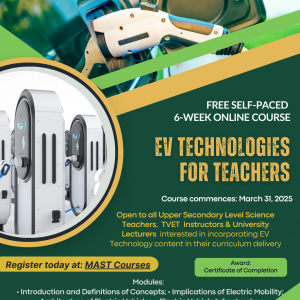
A 6-week self-paced online course: EV Technologies for Upper Secondary Level Science Teachers, TVET instructors and University Lecturers who wish to incorporate electric vehicle (EV) content in their programmes. More information can found Mona Academy of Science and Technology (MAST),. This course is offered by the University of the West Indies, Mona through the Mona Academy of Science and Technology (MAST). Click here to register: Mona Academy of Science and Technology Registration Form
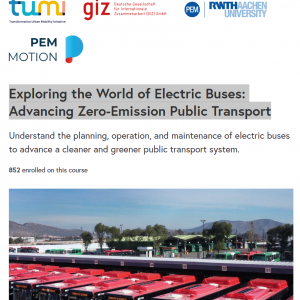
Online self-paced 6-week introductory course on electric mobility and the pathway to the integration of e-mobility in sustainable urban transport systems. The Course uses interviews, articles, videos and readings to prepare you for the future of public transport.. The course can be accessed via Exploring the World of Electric Buses: Advancing Zero-Emission Public Transport The course is offered by TUMI (Transformative Urban Mobility Initiative), who is funded by the German Federal Ministry for Economic Cooperation and Development (BMZ) and implemented by Deutsche Gesellschaft für Internationale Zusammenarbeit (GIZ) GmbH in collaboration with all TUMI partners.
.png)
A thesis submitted O'Neil Jesse Nelson in fulfilment for the degree of Master of Engineering to the Auckland University of Technology. The thesis explores the feasibilty of utility scale photovoltaic plants in Jamaica by combatting trechnical challenges with microgrids.
.png)
Floating solar photovoltaic installations open new opportunities for scaling up solar generating capacity, especially in countries with high population density and competing uses for available land. Advantages of floating solar over land-based systems include higher energy yield, reduced evaporation, and improved water quality, among others. Combining floating solar with hydropower plants is of particular interest. Flexible hydropower output can be used to smooth the variability of the solar generation, while making better use of existing transmission assets, particularly beneficial in countries with weak grids. With a global estimated potential of 400 gigawatts, under conservative assumptions, floating solar could double the...

