

This report seeks to make a contribution to scaling up energy efficiency through improved planning and design of energy efficiency interventions in the developing countries by starting with the basic management principle of What gets measured gets done. The report reviews global experience with the measurement and verification (M and V) of energy efficiency and the emerging field of recognizing the multiple benefits of energy efficiency (MBEE). Through the references, examples, data and practices highlighted in this report, this reports seeks to help practitioners demonstrate the performance of energy efficiency interventions. The overarching objective is to enable project developers, policy...

The energy sector worldwide faces growing challenges related to rising demand, efficiency, changing supply and demand patterns, and a lack of analytics needed for optimal management. These challenges are more acute in emerging market nations. Efficiency issues are particularly problematic, as the prevalence of informal connections to the power grid means a large amount of power is neither measured nor billed, resulting in losses as well as greater CO2 emissions, as consumers have little incentive to rationally use energy they don’t pay for. The power sector in developed nations has already begun to use artificial intelligence and related technologies that...

The CESaRE Webinar Series entitled Are we doing enough? Featuring Dr Kimberly Stephenson, Lecturer, UWI Mona, Jason Robinson, CEO, Solar Buzz and Dr. Indra Haraksingh, Senior Lecturer, UWI St. Augustine.
Key Words: small island state, Antigua and Barbuda, Renewable Energy, Nationally Determined Contribution, 100% RE, Climate Change,

This report presents the proposed Draft for the Sustainable Energy Action Plan (SEAP) for Antigua & Barbuda (A&B). The SEAP delineates achievable target quotas for the NEP’s five goals (energy cost reduction, diversification of energy sources, electricity reliability improvement, environmental protection and stimulate new economic opportunities) as well as four strategies (general cross-cutting strategy, energy conservation and energy efficiency, renewable energy development and education and awareness) for achieving these goals. For each of the four strategies outlined, goals and objectives, specific actions to be implemented, responsible agency per each action, appropriate indicators to measure its outputs, level of priority (short,...
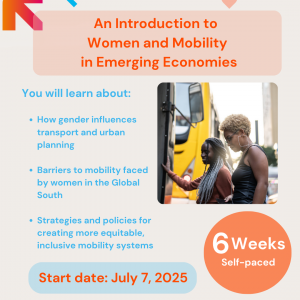
An Introduction to Women and Mobility in Emerging Economies, available from July 7. Across the globe, women encounter distinct mobility challenges that affect their access to education, healthcare, employment, and autonomy. These challenges are especially pronounced in emerging economies, where infrastructure and policy gaps often deepen gender disparities. This course provides a foundational understanding of the relationship between gender, mobility, and urban development in the Global South—and how inclusive, transformative transport policies can drive equity and sustainable progress. What you'll learn: Insights from international experts on gender and mobility Real-world case studies illustrating barriers faced by women in emerging economies...
A 7-week, 7 module online course on language and narratives shaping views on mobility, transport policy and mobility innovation, using homo-economicus model. The course can be accessed via Alternative Mobility Narratives The course is offered by the University of Amsterdam through the Coursera platform.
(1).png)