
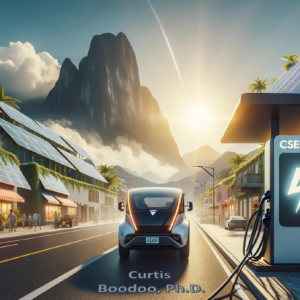
Presentation done by Dr. Curtis Boodoo, University of Trinidad and Tobago, at the Caribbean Sustainable Energy Forum (CSEF VIII), which took place in Kingston, Jamaica, from November 7-9, 2023. The theme for CSEF VIII was ‘Powering Transport’. Connect with key national, regional, and international energy stakeholders who share the goal of accelerating the CARICOM Member States’ sustainable energy transition. Keywords: CSEF 2023Click to download: Session 2 – Transportation – EV – Dr. Curtis Boodoo UTT
TOOL - Transport Inventory and Greenhouse Gas Emission Reporting (TrIGGER) is a bottom-up spreadsheet model to calculate national transport GHG inventories. Click to access: Transport Inventory and Greenhouse Gas Emissions Reporting Tool - Changing Transport Keywords: Emissions calculator
Transport for Inclusive Development: Defining a Path for Latin America and the Caribbean discusses the role that transport often plays in deepening social disadvantage and poverty, on the one hand, and its potential, on the other, to break the cycle of poverty and inequality through investments and policies that better consider the needs of poor and socially excluded groups. Keywords: Transport, Social Inclusion, Development, Latin America, Caribbean Click to download: Transport-for-Inclusive-Development-Defining-a-Path-for-Latin-America-and-the-Caribbean-1
2-part course, 9 weeks, exploring the impacts of motorization, current unsustainable travel patterns, and the framework for changing to sustainable urban mobility. The course can be accessed via Transforming Urban Mobility Course. The course is offered by TUMI (Transformative Urban Mobility Initiative), who is funded by the German Federal Ministry for Economic Cooperation and Development (BMZ) and implemented by Deutsche Gesellschaft für Internationale Zusammenarbeit (GIZ) GmbH in collaboration with all TUMI partners.
Online self-paced 6-week introductory course to sustainable and equitable solutions in urban mobility, and to the “living labs” model: a method of co-development among public and private actors, researchers, and civil society to accelerate innovation in climate action and sustainable urban planning and development. The course can be accessed via MITx: Transformative Living Labs in Urban Climate Action and Transportation Planning The course is offered by Massachusetts Institute of Technology (MIT) through the edX platform.

This paper uses simple analytical models to study high-income donor countries' willingness to pay to supply mitigation finance to low-income countries; how this depends on modality for finance supply; and how it changes as the global greenhouse gas mitigation agenda moves forward. The paper focuses on two modalities: transformational project-based mitigation finance (transitioning from fossil to non-fossil energy use at scale), and transformational policy-based mitigation finance support (implementing comprehensive carbon taxation). These modalities are compared with conventional finance for which donors have lower willingness to pay. High-income countries' willingness to pay is higher when mitigation is combined with carbon taxation;...

Tracking SDG7: The Energy Progress Report provides the international community with a global dashboard to register progress on the targets of Sustainable Development Goal 7 (SDG7): ensuring universal energy access, doubling progress on energy efficiency, substantially increasing the share of renewable energy, and enhance international cooperation to facilitate access to clean and renewable energy by 2030. It assesses the progress made by each country on these targets and provides a snapshot of how far we are from achieving SDG7. The report is a joint effort of the International Energy Agency (IEA), the International Renewable Energy Agency (IRENA), United Nations Statistics...

The Global Energy Progress Report 2019 provides a global dashboard on progress towards Sustainable Development Goal 7 (SDG7), which sets 2030 targets for reaching universal access to electricity and clean fuels and technologies for cooking, substantially increasing the share of renewable energy in the global mix, and doubling the rate of improvement of energy efficiency. All the data used in this pamphlet comes from the respective official source: for electrification, the World Bank; for clean fuels and technologies for cooking, the World Health Organization (WHO); for renewable energy, the International Energy Agency (IEA), the United Nations Statistics Division (UNSD) and...

Emissions from the power sector (from both electricity and heat production) declined almost 3% in 2020, or 0.4 Gt CO2, the largest-ever decline, while emissions intensity decreased 2.8%. These trends result from reduced electricity demand during the Covid-19 pandemic and a record share of renewables in total generation (29%) in 2020. Electricity demand is expected to increase in 2021 as economic activity rebounds and major emerging economies expand rapidly. This sector’s transformation is critical to clean energy transitions, as power generation accounts for 40% of energy-related CO2 emissions and electricity is increasingly being used to meet end-use energy demand. Current...

