
Achieving the Sustainable Development Goals (SDGs) over the next 30 years will critically depend upon urban land use and infrastructure development actions taken across multiple sectors (buildings, energy, transportation, water-sanitation, and waste) in global cities. Integrated urban planning addresses a multiplicity of urban sustainability objectives (e.g., economy, environment, inclusivity, and resilience) (GPSC, World Bank 2018), including cross-sectoral and cross-scale linkages (Ramaswami et al. 2016) and connection of physical planning with social, cultural, behavior, and policy dimensions. The objective of this report is to review the state of knowledge (science) and the state of practice (models actually used by cities for...
.png)
Achieving global goals for access to energy and mitigation of climate change will require a quadrupling of present levels of solar photovoltaic (PV) generation in the developing world by 2025 to reach around 950 gigawatt (GW)1. This represents an investment of more than US$500 billion in new solar PV generation alone. To reach this objective, large amounts of private funding will have to be unlocked to complement the limited public financing available. Yet most developing countries still lack a pipeline of bankable solar projects for consideration by the private sector. To develop one, countries must take a series of key...

(1).png)
A 7-week, 7 module online course on language and narratives shaping views on mobility, transport policy and mobility innovation, using homo-economicus model. The course can be accessed via Alternative Mobility Narratives The course is offered by the University of Amsterdam through the Coursera platform.

This report presents the proposed Draft for the Sustainable Energy Action Plan (SEAP) for Antigua & Barbuda (A&B). The SEAP delineates achievable target quotas for the NEP’s five goals (energy cost reduction, diversification of energy sources, electricity reliability improvement, environmental protection and stimulate new economic opportunities) as well as four strategies (general cross-cutting strategy, energy conservation and energy efficiency, renewable energy development and education and awareness) for achieving these goals. For each of the four strategies outlined, goals and objectives, specific actions to be implemented, responsible agency per each action, appropriate indicators to measure its outputs, level of priority (short,...
Key Words: small island state, Antigua and Barbuda, Renewable Energy, Nationally Determined Contribution, 100% RE, Climate Change,
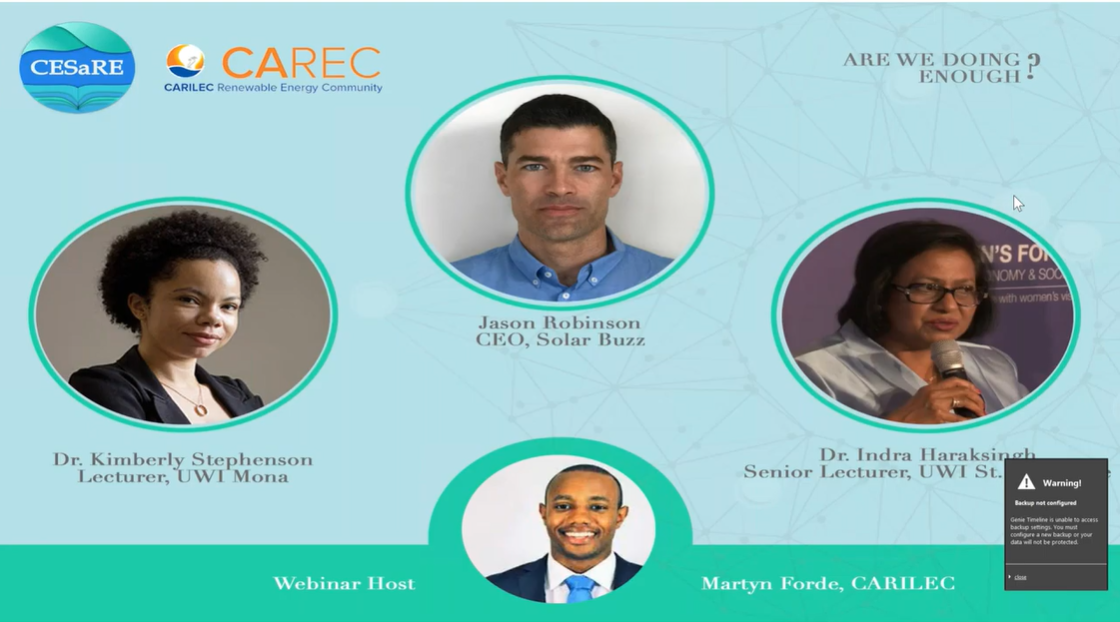
The CESaRE Webinar Series entitled Are we doing enough? Featuring Dr Kimberly Stephenson, Lecturer, UWI Mona, Jason Robinson, CEO, Solar Buzz and Dr. Indra Haraksingh, Senior Lecturer, UWI St. Augustine.

