
Although geothermal energy is globally recognized as a clean and reliable source of heat and electric power its development can inadvertently lead to adverse outcomes that disproportionately disadvantage women. Based on good practices and lessons learned, this report introduces ways that geothermal projects can mitigate risks and pursue opportunities to address gender gaps within the project cycle. It outlines the risks and opportunities associated with (i) changes in land and natural resource use, (ii) changes to employment and economic patterns, and (iii) changes to environment and health. Beyond mapping risks and opportunities, the report makes the case for focusing on...
.png)
Floating solar photovoltaic installations open new opportunities for scaling up solar generating capacity, especially in countries with high population density and competing uses for available land. Advantages of floating solar over land-based systems include higher energy yield, reduced evaporation, and improved water quality, among others. Combining floating solar with hydropower plants is of particular interest. Flexible hydropower output can be used to smooth the variability of the solar generation, while making better use of existing transmission assets, particularly beneficial in countries with weak grids. With a global estimated potential of 400 gigawatts, under conservative assumptions, floating solar could double the...
Well-integrated planning models can help cover the whole planning spectrum - from the national level down to granular distribution at the village level. Integration of models is critical to ensure that investment plans are realistic and accurately reflect the costs that utilities face in practice. The foregoing review of power system planning models and sophisticated stand-alone geographic information systems (GIS) - based models suggests the following questions: is there a need to bring the two paradigms closer? If so, do analytical frameworks exist to accomplish the task? Key word: technology need; increase in energy consumption; Access to Electricity; power system...


ESMAP’s Annual Report 2018 represents a comprehensive summary of the breadth and reach of ESMAP’s portfolio of activities. It provides snapshots of concrete results to illustrate the impact of ESMAP’s work as it helps countries strengthen the performance of their energy sectors. In 2018, ESMAP informed USD 8.6 billion in World Bank development financing and mobilized USD 7 billion in external financing. ESMAP also launched and disseminated key knowledge products to help shape global energy policy, trigger reform, and increase smart investments in the sector. Keywords: mini grid; offshore wind; poverty and social impact analysis; Access to Electricity; Clean Technology...

In the clean energy transition, the value of natural gas infrastructure is very important for operating the energy system. Gas-fired power plants contribute to optimized energy systems when they are designed to operate flexibly, responding to demand patterns and the variable supply of renewable energy. Smart electricity grids, renewable energy, battery storage technology, and gas-fired power plants in combination will generally be the lowest cost, low-carbon solution to the growing energy requirements of emerging markets. Private investors and financiers are responding to these opportunities, but the full potential will only be reached with improvements in policy, regulation, and procurement in...

The World Bank is committed to addressing gender equality in energy operations as part of both its new gender strategy and its gender monitoring system,known as the Gender Tag. The World Bank Group Gender Strategy (FY16–23) focuses on four main objectives: (i) Improving Human Endowments; (ii) Removing Constraints for More and Better Jobs; (iii) Removing Barriers to Women’s Ownership and Control of Assets; and (iv) Enhancing Women’s Voice and Agency and Engaging Men and Boys; The Gender Tag asks teams to establish strong links among gender analysis, actions, and monitoring and evaluation. It expects teams to establish a logical results...

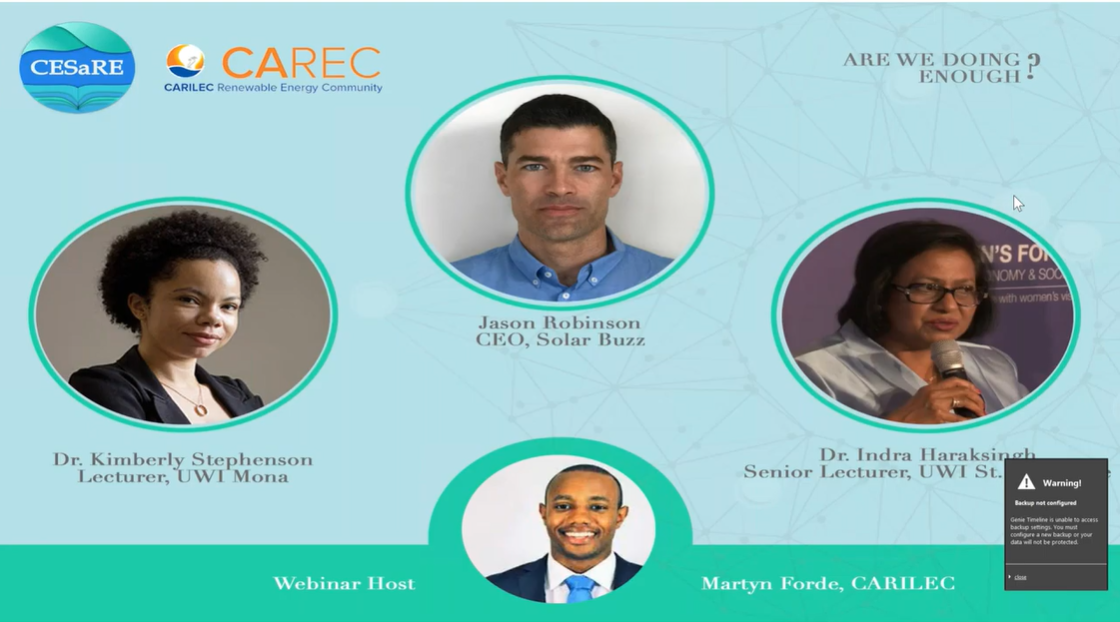
The CESaRE Webinar Series entitled Are we doing enough? Featuring Dr Kimberly Stephenson, Lecturer, UWI Mona, Jason Robinson, CEO, Solar Buzz and Dr. Indra Haraksingh, Senior Lecturer, UWI St. Augustine.

