
Asha Trimmingham
Published on June 15, 2026

Data, Hills and Green Jobs: Saint Lucia’s Transition to E-Vehicles Advances
By Tecla Fontenard, Communications Specialist, NDC-TEC Programme
In the global theatre of climate action, the narrative is often communicated by high-level pledges and abstract targets. But, on the winding, mountainous roads of Saint Lucia, the transition to a low-carbon future is becoming tangibly visible. With the handover of 22 electric vehicles (EVs) to the Government of Saint Lucia, the NDC-TEC Project – funded by Germany’s International Climate Initiative (IKI)- has effectively moved the needle from policy to practice.
Critics of electric mobility often point to the Caribbean’s challenging geography – characterized by steep gradients and high temperatures – as a barrier to adoption. But, the NDC-TEC pilot is designed specifically to dismantle these assumptions, asserts Ina de Visser, Head of the NDC-TEC Programme: “Saint Lucia is very suitable for EVs’. Firstly, because the distances are small, the range on a full battery is between 350 and 420 kilometres. Secondly, the hilly terrain is not a bad thing at all. The electric vehicles outperform traditional fuel vehicles on torque, so going up a steep hill, you’ll actually be faster, not slower, while going down the hill, regenerative braking ensures that while you brake, you charge your battery.”
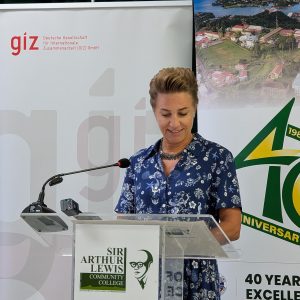
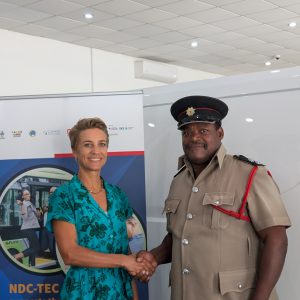
Building on the suitability, de Visser emphasizes that the true value of the pilot lies in testing the vehicles across Saint Lucia’s most demanding public sectors. Rather than keeping the fleet in low-stakes environments, the project has intentionally placed them where operations are critical and terrains are unpredictable – including unpaved backroads utilized by the Water and Sewerage Company (WASCO). By tracking how different agencies deploy these vehicles, the pilot offers a comprehensive, real-world data lab. Each department brings a unique operation profile, for example, the Police and Fire Services demand high performance response capabilities and maximum up time, while the Ministry of Education and the Sir Arthur Lewis Community College follow routine, predictable transit patterns. At the same, the EVs are directly embedded into educational spaces. With this education integration, the fleet is transformed into a different type of asset. “These electric vehicles will not only support our operational needs but will also serve as living learning tools. We commend the Government of Saint Lucia and its partners for moving decisively from policy to practice”, said Dr. Madgerie Jameson-Charles, upon receiving one of these vehicles for the Community College.
What sets this initiative apart from a standard procurement exercise is its focus on evidence-based scaling. Each of the 22 units is equipped with advanced telematics that monitor energy consumption, battery health, charging and driving behaviour and mileage in real time. “The telematics allows us to validate the technical analysis that we did before’’ explains Mr Antonio Sealy, E-mobility Advisor for the NDC-TEC Programme. Sealy is eager to compare the manufacturers’ assumed efficiency metrics with “real world Saint Lucia condition” noting that the island’s undulating roads and mountainous terrain, might provide a unique performance outlook.
This ‘live evidence’ serves a dual purpose. First, it allows the precise calculation of greenhouse gas (GHG) emission reduction, feeding directly into Saint Lucia’s reporting requirements under the Paris Agreement. Second, it provides the technical roadmap to safely integrate EV into the national fleet, supporting the government’s ambitious target of 30% public fleet electrification by 2030.
For the Government of Saint Lucia, transitioning the public fleet is about global solidarity and regional leadership. The island has committed to a 22% greenhouse gas emission reduction in the energy and transport sectors by 2035 (relative to 2010 levels). “Even though we contribute negligibly in terms of greenhouse gas emissions, we try to operate in solidarity with the rest of the world”, says Ms Dawn Nathoniel, Chief Sustainable Development and Environment Officer in Saint Lucia’s Department of Sustainable Development.
Nathoniel describes the initiative as “leading by example” explaining that the government plans, as articulated in NDC 3.0, to reduce emissions specifically through “enhanced deployment of wind and solar energy with battery storage, upgrades to the grid infrastructure, continued efforts to improve energy efficiency, and enhanced uptake of electric vehicles.” According to Nathoniel, “transitioning to electric mobility will be supported by investments in charging infrastructure, fiscal incentives, capacity building, public sensitisation and buy-in campaigns and pilot demonstrations, like this one, supported by the German Government“. Further she emphasizes that “with low carbon technologies like EVs, we can demonstrate viability to the general public, giving them the confidence that they are able to move forward with electric vehicles.”
While this handover marks a victory for Saint Lucia, the NDC-TEC project (2022-2028) is designed as a regional catalyst for the wider Caribbean. The project is implemented by GIZ and funded by the Federal Ministry for the Environment, Climate Action, Nature Conservation and Nuclear Safety, under the International Climate Initiative (IKI).